Skin, Voice, Dream: Reverie at the Edge
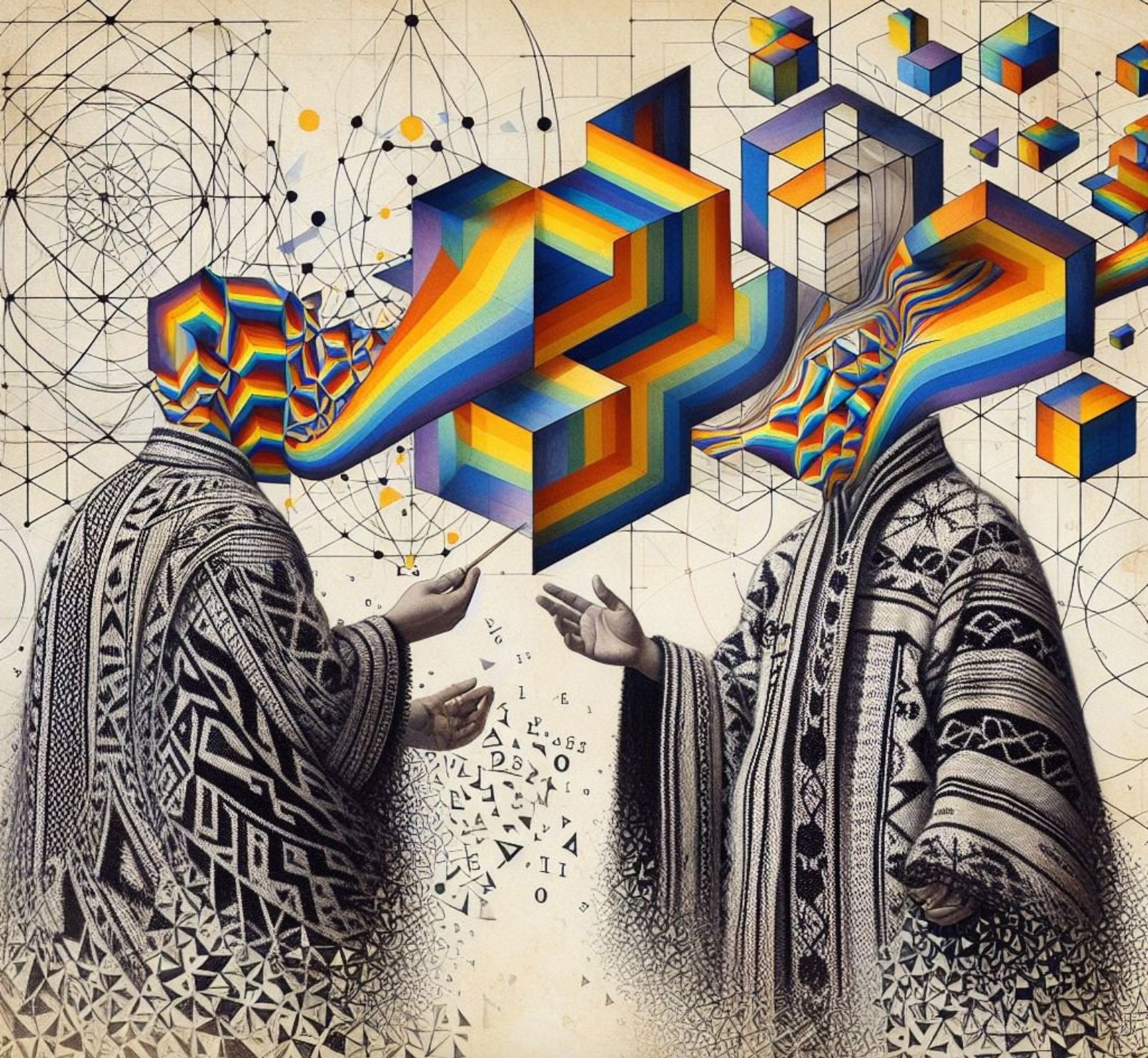
“Frequency Modulations” by Nova Orison
My soul radially whorls out to the edges of my body,
according to the same laws by which stars shine,
communicating with my body by emanation.
—Mei-Mei Berssenbrugge, Hello, the Roses
Surface area describes the exposed exterior of an object—the place where an object is in contact with its surrounding environment. And the greater the surface area, the greater the interaction. In biology, the surface area of the lungs (~700 square feet!) is increased through the fine branching of bronchioles and alveoli, structures that maximize contact with and absorption of oxygen. The dendritic spines of neurons increase their surface area, allowing for more synaptic connections and, thus, more complex thought and memory networks. In the digestive process, saliva increases the surface area of food to make it more available for enzymatic digestion. In the garden, well-aerated, porous soil improves the growth of plants by increasing the surface area available for microbial activity, water retention, and root contact.
In the material world, increased surface area means increased interaction—With oxygen, with heat, with microbes.
What if we expand this concept beyond the purely physical?
What about the surface area of a thought, a felt experience, a dream, a memory, a word, a voice, a relationship?
Reverie
One place to observe this expansion of psychic surface area is in psychoanalyst Wilfred Bion’s concept of reverie.
Bion proposed that the mind plays a kind of digestive function for raw sensory-emotional experience. He called these unprocessed experiences beta elements: fragments that cannot yet be consciously experienced. In order for these elements to become thinkable, they must make contact with a psychic process he called alpha function. He described this state of mind as a kind of reverie—a receptive, non-intrusive form of attention that quietly absorbs, metabolizes, and makes these sensory-emotional components available to conscious thought. In this way, reverie increases the surface area of the mind, allowing contact with experience that would otherwise remain unformulated.
The Word Grows Green
The surface is not just a boundary, but a site of transformation. This paradox is beautifully captured in the word cleave, a contranym (i.e., a word with two opposite meanings), meaning both to join and to sever. One can almost feel the contradiction humming within the word when it’s used to describe how a baby “cleaves” to the mother’s breast.
Ordinary, everyday speech often aims to reduce the proliferation of meaning. It seeks to close the gap between intention and reception by transmitting a specific piece of information with as little ambiguity as possible. This dimension of speech is essential to the functioning of life within the human community. “I’ll be there at 1:00” is not an invitation to interpretation. It’s meant to be taken at face value. This kind of communication compresses the surface area of meaning so that the message passes smoothly into the listener’s mind.
But speech has a way of complicating itself. Of fraying at the edges. Of folding in on itself. Of proliferating into poetry. Even the most ordinary utterances, placed in the right context, can begin to shimmer with unintended significance. This is the oracular domain of speech.
You open, land,
your mouth full of water,
your body gushes sky,
you burst, land,
your seeds explode,
the word grows green
—Octavio Paz, Blanco
A mother drops her daughter off at school and says, “Be good for your teachers today.” On the surface, it’s a simple behavioral injunction: say please and thank you, be kind to your classmates, listen to your teachers. But what exactly does good mean? And why is this important to you? What will happen if I’m not good? Is love contingent on my goodness? For the child, this simple injunction may reverberate for years, transforming into a question that haunts her sense of self: Am I good?
Oracular speech produces multiplicity instead of clarity. It resists closure and invites projection by stirring the unconscious into movement. Each word becomes a site of iridescent diffraction, not convergence. Where ordinary speech attempts to resolve uncertainty, oracular speech preserves it.
What matters is not the specific meaning of the utterance but how it reverberates within the listener—how it provokes the unconscious into communication, how it sets in motion a chain of meaning that reveals something of the person’s way of organizing self, other, and world.
“It is when patients begin to throw things into question—when the what, why, and who of their utterances becomes problematic to them—that they are genuinely engaged in analysis. It is at this point that they are engaged in something which goes beyond the simple demand to be relieved of one or more specific symptoms. Everything becomes questionable; what was most certain is no longer at all certain, and they are now open to listening to the unconscious, to hearing the other voice that speaks through them, and to attempting to decipher it.”
—Bruce Fink, A Clinical Introduction to Lacanian Psychoanalysis
This is part of what makes the psychoanalytic conversation different from ordinary conversation. At times, the words of the therapist are meant to disrupt the normal flow of associations, inviting the patient to encounter a dimension beneath language. Not to frustrate, but to uncover. To touch what is usually papered over by the regulating function of everyday speech. Just as saliva increases the surface area of food to make it more available to enzymes, oracular speech increases the surface area of language, making it more available to the transformative power of unconscious association and reverie.
Blooming Borders
I effuse my flesh in eddies, and drift it in lacy jags.
I bequeath myself to the dirt to grow from the grass I love,
If you want me again look for me under your boot-soles.
—Walt Whitman, Song of Myself
In this poetic sleight-of-hand, Whitman seems to transpose his whole being onto the surface of the earth. By bequeathing himself to the dirt to grow from the grass, he borrows the seemingly infinite surface area of the earth in order to increase the reach of his singular voice.
To appear wherever you might be. To elide the space between you and him. To make himself infinite, depending on the place from which you are touched by his words.
This calls to mind the coastline paradox, wherein the apparent length of the coastline changes depending on the scale at which it is measured. The closer and more finely you measure (i.e., with smaller and smaller units), the longer the coastline becomes. This results from the fact that coastlines are not smooth and straight. They are fractal boundaries riddled with inlets, curves, and intricate irregularities that multiply as you attend to them more closely.
Surface is not a smooth boundary but an ever-unfolding event. And this maps cleanly onto the psyche: the more attention we give to a dream, an affect, a symptom, the more its contours multiply. This sort of psycho-analysis increases psychic surface area.
Flesh of the World
“Chiasm” or “the crossing of the world” is what philosopher of perception Maurice Merleau-Ponty called the boundary between self and other, as exemplified by the double sensation that occurs when two hands touch. Here, to touch is to be touched. Boundaries establish contact and contact establishes boundaries. Intimacy and aloneness bloom from the same rootstock, entwined from conception, ever weaving the far and the near.
“The ego is first and foremost a bodily ego; it is not merely a surface entity, but is itself the projection of a surface….The ego is ultimately derived from bodily sensations, chiefly from those springing from the surface of the body. It may thus be regarded as a mental projection of the surface of the body….A person’s own body, and above all its surface, is a place from which both external and internal perceptions may spring.”
—Sigmund Freud, Ego and Id
The skin is the largest organ of the body, forever mediating the within and the without. Following Freud, one could say that identity and difference are formed and felt most acutely here, at the surface. In the flesh.
The skin, when attended to mindfully, increases in surface area. Sensations contained and reduced within a thought (e.g., “my knee aches”) bloom with attention. The ache unfolds into a plethora of textures (“crunchy,” “smooth,” “jagged”), temperatures (“there’s a bright warmth”), and spatial relationships (“the left side of the knee feels like it’s tugging on the midline”). This increase of the phenomenological space of the event constitutes a simultaneous increase in the surface of the mind.
As those engaged in meditation retreats often attest, this expansion of attentional capacity (i.e., mindfulness) is accompanied by a decrease in suffering. Mindful attention (curious, open, spacious) allows the ache to unfold across a larger perceptual field. It disperses. It transforms. It blossoms into space.
From a psychoanalytic perspective, we might say that such awareness increases the surface area available for mentalization, the transformation of raw, pre-symbolic affect into something that can be represented, reflected upon, and held. What begins as pain becomes describable, dreamable. Attention here functions like reverie: it opens a space for the unthought to take form.
This echoes Winnicott’s notion of transitional phenomena, wherein a child uses a particular object (a blanket, a toy, a lullaby) to navigate the space between self and other, inside and outside. These transitional experiences expand the psychic surface area necessary for reality-testing, symbolic formation, and play. In the adult psyche, mindfulness performs a similar function by creating a transitional space in which the boundary between sensation and thought becomes fluid, creative, and transformative.
Across domains—lungs, speech, soil, dream, skin—the more textured the surface, the more life it can hold. Surface area, then, is anything but superficial. It addresses Gaston Bachelard’s idea of intimate immensity, wherein the most minute surface (a shell, a puddle, a whisper) contains infinite space if attended to closely enough.
Surfaces illuminate the place where the world brushes against us…and where we, in turn, touch back.
Then flesh dissolved, glances congealed, the heart’s pulse stopped,
and the great mind leapt to the peak of its holy freedom,
fluttered with empty wings, then upright through the air
soared high and freed itself from its last cage, its freedom.
All things like frail mist scattered till but one brave cry
for a brief moment hung in the calm benighted waters:
‘Forward, my lads, sail on, for Death’s breeze blows in a fair wind!’
—Nikos Kazantzakis, The Odyssey: A Modern Sequel